
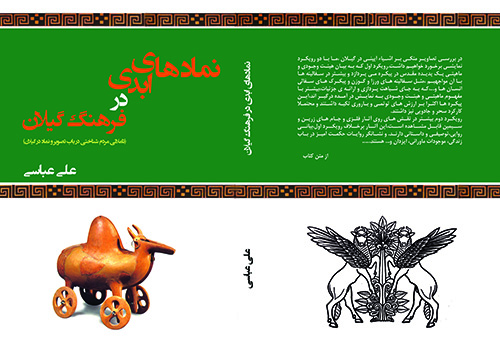
(2020) Eternal Symbols in Culture of Guilan, By Ali Abbasi Roudposhti, Bloor Publisher, Rasht, Iran.
Cultural anthropology relies on non-instinctive traits and what humans acquire through growth and education in a specific culture. Culture is a mixture of cognitions, values and knowledge, reactions and behaviors, beliefs and rituals. Culture bears resemblance to customs and constructions that the members of each society use in adapting to their world in proportion to each other.
One of the fields of cultural anthropology is art, and by studying artworks and their social and cultural applications, their consequences can be studied and analyzed in a collective context.
In this book, articles concerning visual culture, have been collected. These articles do not generally follow a specific historical and chronological order, but examine the items by topics. In the examination of objects, images, and visual discoveries, both pre-Islamic visual culture and post-Islamic artistic productions have been used.
In the approach of this article, instead of research based on the history of art, an attempt has been made to emphasize the anthropological aspects of the phenomena to look at art as a cultural phenomenon. Therefore, such an approach includes all forms of visual and imaginative activities. It includes body decoration, clothing, everyday objects, ornaments, masks, stories and legends, dances and other phenomena. Therefore, this dimension does not only deal with cultural objects and artistic productions, but by penetrating and delving into the surviving society, it also brings the spiritual heritage to a link with them.
Contents:
1- Preface
2- Investigating of mythical thoughts and beliefs in ancient Gilan
3- The myth of creation and the martyred god
4-Eternal symbols (Part 1)
5- Eternal symbols (part2)
6- Metaphor of the cup
7- Trees and plants in the visual culture of the people of Gilan
8- Reflection of the myth of the sacred cow in ancient Gilan
9- Form and motifs in Talesh’s ancient works
10- Illustrated version of Shahnameh of Lahijan
11- The background of shrine paintings and religious images in Gilan
12- Native arts with plant elements and wooden ritual symbols
13- References